You have this brilliant idea in your head. Maybe it's a marketing campaign that will finally cut through the noise. Perhaps it's a technical specification document that needs to be perfect for your stakeholders. Or maybe you are trying to create an image that captures something you can visualize perfectly but cannot quite articulate.
You type your request into ChatGPT. Or Claude. Or Nano Banana. You hit generate.
And what comes back is... fine. It is technically correct. It checks the boxes. But it is also generic. It is the same thing anyone else would have gotten with those same words. The magic you imagined? Nowhere to be found.
That disconnect is not a failure of artificial intelligence. The models are incredibly powerful. The problem is that most of us do not naturally think in the structured, detail-rich format that produces extraordinary results. We think in concepts, feelings, and half-formed visions. We know what we want when we see it, but articulating it upfront? That is where everything falls apart.
This is the fundamental challenge of prompt engineering. And it is also why the field has been evolving beyond simple templates and trick phrases toward something far more sophisticated.
The Communication Gap
Think about the last time you asked someone to help you with a creative project. A good collaborator does not just take your first sentence and run with it. They ask questions. They probe for context. They want to understand not just what you are asking for, but why you are asking for it and what success actually looks like.
Most AI interactions skip this entirely. You type something. The model guesses at everything you left unsaid. And then you spend the next hour iterating, refining, and trying to wrestle the output toward what you actually wanted.
This is not just inefficient. It fundamentally limits what you can achieve. Complex, nuanced outputs require complex, nuanced inputs. When you are building multi-step workflows or creating content that needs to hit specific emotional notes, that initial vagueness compounds into significant quality gaps.
The irony is that the information exists. You know the role you are applying for. You know your brand voice. You understand the technical constraints. But traditional prompting forces you to guess which details matter and hope you included enough context for the AI to work with.
What if the process started differently? What if, instead of you trying to anticipate what the AI needs, the system figured out what was missing and asked?
Context Gathering: The Questions That Transform Outputs
The most effective prompt engineers have always known that the real work happens before you hit generate. The best prompts are not clever tricks. They are comprehensive context packages that give the AI everything it needs to produce something genuinely tailored.
But building those context packages manually requires expertise. You need to know which details matter for which types of tasks. You need to understand how different AI models process information. And you need the discipline to slow down and think through your request instead of just firing it off.
This is where intent-first engineering comes in. The idea is simple but powerful: analyze the initial request, assess what is clear and what is ambiguous, and generate relevant follow-up questions designed to fill exactly those gaps.
Consider what happens when you type "Write a cover letter" into a traditional AI tool. Without additional context, the model has to guess at the role, industry, company culture, your experience level, and the tone you want to strike. The result might be competent, but it will never be personal.
An intent-first approach recognizes that "Write a cover letter" is not a complete request. It is a starting point. GOATIMUS identifies what it needs to know: What role are you applying for? What industry is the company in? What tone fits the culture? What is your experience level?
Your answers flow directly into the prompt generation process. The output is not just technically correct; it's genuinely tailored to your situation.
For creative requests, the questions shift accordingly. An image prompt might trigger questions about aspect ratio, visual style, lighting mood, or subject emphasis. A video prompt might ask about duration, camera movement, or narrative arc. GOATIMUS is intelligent enough to recognize when questions are not needed. Simple, clear requests skip the context phase entirely. There is no friction when you do not need it and meaningful dialogue when you do.
The Model Selection Problem
Here is a truth: different models are dramatically different at different tasks. The model that excels at processing messy, unstructured data might struggle with complex multi-step reasoning. The model optimized for creative writing might not deliver the technical precision you need for documentation.
Most users pick a model based on familiarity or brand recognition. They stick with ChatGPT because they know it, or they use Claude because someone recommended it. But this approach leaves significant capability on the table.
The emerging solution involves what we call entropy assessment. The concept measures two dimensions of any given request.
Context entropy evaluates how complex or messy your input is. Are you uploading files? Working with large amounts of unstructured text? Including images or raw data? High context entropy means the AI needs to digest and organize substantial information before it can help.
Task entropy measures how open-ended your goal is. Are you asking for brainstorming with multiple valid directions? Do you have vague objectives that require interpretation? High task entropy means the output space is broad and the AI needs to make creative choices.
Different model architectures handle these combinations differently. A model like Gemini tends to excel at processing messy inputs when the goal is clear. Claude handles situations where both context and task are complex through its structured thinking approach. For straightforward requests with clean inputs, a faster model like Grok can be more efficient.
Understanding this landscape changes how you approach prompt engineering. Instead of asking "what is the best AI," you start asking "what is the best AI for this specific task with this specific input?"
Speaking Each Model's Native Language
Here is another insight that separates expert prompt engineers from everyone else: the same prompt produces dramatically different results depending on which tool you are using.
Midjourney interprets prompts using its own syntax. Aspect ratios with specific flags. Stylization parameters. Chaos controls. Weighted terms separated by special characters. If you do not know the syntax, you are leaving significant capability untapped.
Flux processes prompts through rectified flow diffusion, which means front-loading critical subjects produces better results. The order and structure of your prompt matters in ways that are not obvious if you are treating it like natural conversation.
ChatGPT works well with the RICCE (Role, Intent, Condition, Context, Example) framework. Claude responds best to XML-structured prompts. Gemini thrives with context-first approaches. Grok prefers minimal, direct instructions.
This is not cosmetic formatting. It is the difference between prompts that work and prompts that work optimally for your specific tool. Expert users have internalized these differences through trial and error. But there is no reason this knowledge needs to remain tribal.
The concept of model-specific meta-prompting addresses this gap. Instead of you learning the quirks of every model, the prompt engineering system translates your intent into the native syntax of whatever tool you are targeting. You focus on what you want to create. The Goatimus system handles the translation.
This approach extends across the entire ecosystem. Image models like Midjourney, Flux, Nano Banana, chatGPT image-gen, and others. Video models like VEO3 Runway, Sora, and Kling. Text-focused models like Claude, ChatGPT, and Gemini. Each gets a prompt optimized for its specific architecture and strengths.
Escaping the Safe Answer Trap: Verbalized Sampling
Every time you ask an AI for creative help, you are fighting against its training. Large language models have been meticulously aligned to produce what researchers call "safe" outputs. These are competent, conventional responses unlikely to surprise anyone.
This alignment is well-intentioned. Nobody wants AI generating harmful or inappropriate content. But it has a side effect that limits creative applications: mode collapse. The AI has access to a vast probability distribution of possible responses, but alignment pushes it toward the narrow band of answers that feel most familiar and least risky.
You ask for email subject lines and get the five most predictable options. You request marketing angles, but you get the same approaches everyone else gets. The AI is not wrong, exactly. It is just... boring. Safe. Forgettable.
Researchers at Stanford and Northeastern University developed a technique called Verbalized Sampling that addresses this limitation. Instead of asking for one answer, the approach instructs the model to sample across its full probability distribution and generate multiple diverse responses.
The research results are striking: 1.6 to 2.1 times greater creative diversity without sacrificing accuracy or safety.
In practice, this means you can request exploration across the probability space. For text prompts, this generates multiple labeled responses ranging from "Most Common" to "Novel," each with an explanation of why that approach works. You see the full strategic landscape of options instead of just the safest choice.
For image and video prompts, the same principle applies. Instead of one prompt, you receive multiple options, each exploring a different creative direction. Every option includes the complete standalone prompt, a description of the creative angle, and a probability weight indicating how conventional or unconventional the approach is.
The practical impact is immediate. Instead of getting one safe email subject line, you get five distinct strategic angles. Instead of one predictable marketing approach, you see the conventional play, the creative alternative, and the genuinely unconventional option. You choose which direction speaks to your vision instead of accepting whatever the AI decided was safest.
Building Your Prompt Library Over Time
Great prompts should not be single-use. The product description template that worked perfectly for one launch can work for the next one with minor adjustments. The system prompt that produces exactly the right tone deserves to be saved and refined over time.
With Goatimus you can save any generated prompt directly from the output interface. Edit saved prompts to refine them over time. Pin favorites for instant access. Fork prompts from community galleries, taking something close to what you need and customizing it for your specific use case.
This transforms prompt engineering from a generation tool into a development environment. You are not starting from scratch each time. You are building on what works, iterating toward increasingly sophisticated results, and developing a personal library of proven approaches.
Over time, your library becomes genuinely valuable. It encodes your preferences, your brand voice, your technical requirements. New projects start with tested foundations instead of blank pages.
The Meta-Prompting Revolution
All of these concepts point toward a fundamental shift in how we interact with AI. The old model was simple: you write a prompt, you get an output. If the output is not good, you rewrite the prompt and try again. Repeat until satisfied or frustrated.
The new model is more sophisticated. You express your intent. The system gathers necessary context. It recommends the optimal model architecture. It translates your intent into model-specific syntax. It samples across the probability space for creative diversity. And it helps you build a library of proven approaches over time.
This is meta-prompting. Instead of you becoming an expert in every AI model's quirks and optimal syntax, you work with a system that handles that translation. You focus on what you want to create. The engineering happens behind the scenes.
For power users building complex workflows, this means you can finally achieve the precision and consistency you need without manually writing long word prompts. For creative professionals, it means you get genuine diversity and surprise instead of safe, predictable outputs. For business users, it means professional-quality results without requiring deep technical expertise.
The gap between your ideas and what AI delivers is closing. Not because the models are getting dramatically smarter, though they are. But because the interface between human intent and machine capability is finally getting the attention it deserves.
Where This Goes Next
The prompt engineering field is still young. The techniques that seem cutting-edge today will be table stakes within a year. Model architectures will evolve. New capabilities will emerge. The specific recommendations that work right now will need updating.
But the underlying principle is durable: better AI outputs require better communication between humans and machines. That communication can happen through your own expertise, developed over countless hours of trial and error. Or it can happen through systems designed specifically to bridge that gap.
Goatimus exists to handle that bridge. It is a meta-prompt engine that analyzes your goal, gathers necessary context, selects optimal techniques from a library of proven approaches, and generates prompts optimized for whatever model you are targeting. You bring the vision. GOATIMUS handles the translation.
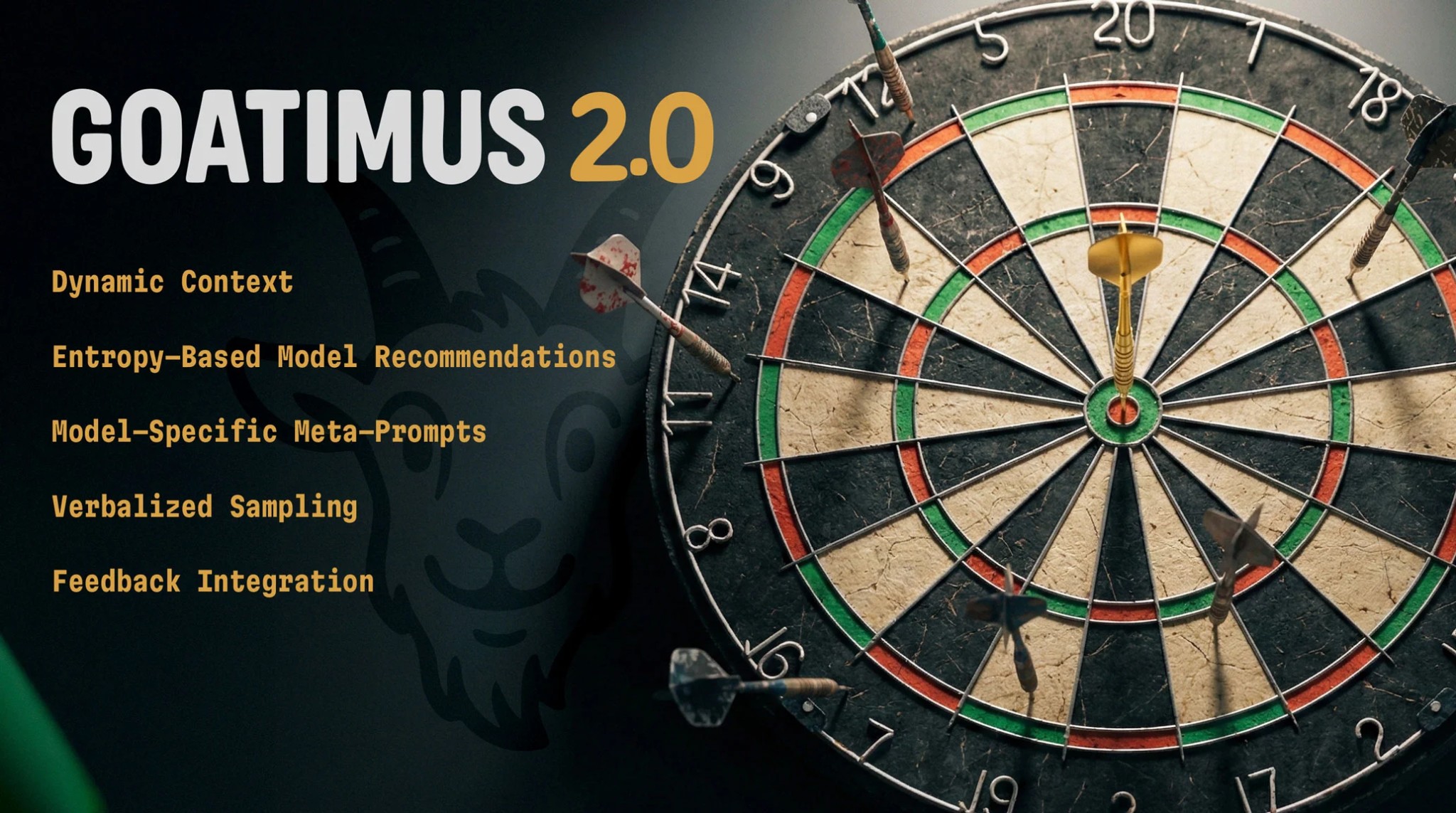
The Ideation and Intent update brings all of these concepts together. Dynamic context ensures you are asked the right questions before anything generates. Entropy-based recommendations match you with the right model architecture. Meta-prompts optimize output for your specific tool. Verbalized Sampling unlocks creative options you would never see otherwise. And your prompt library grows more valuable every time you use it.
If you have ever felt like AI tools are not quite delivering on their promise, this is your opportunity to change that. Not by learning every model's syntax quirks. Not by writing longer and longer prompts. But by working with a system designed to understand what you actually need and translate that into language machines can execute.
Try reusing a prompt you started with before. Notice how the experience feels different when GOATIMUS starts by understanding your intent.
That difference is what this this update delivers.